
Air-Conditioners
Types of Air Conditioners Explained: Which AC Is Right for Your Home or Business?
By Zernons Team
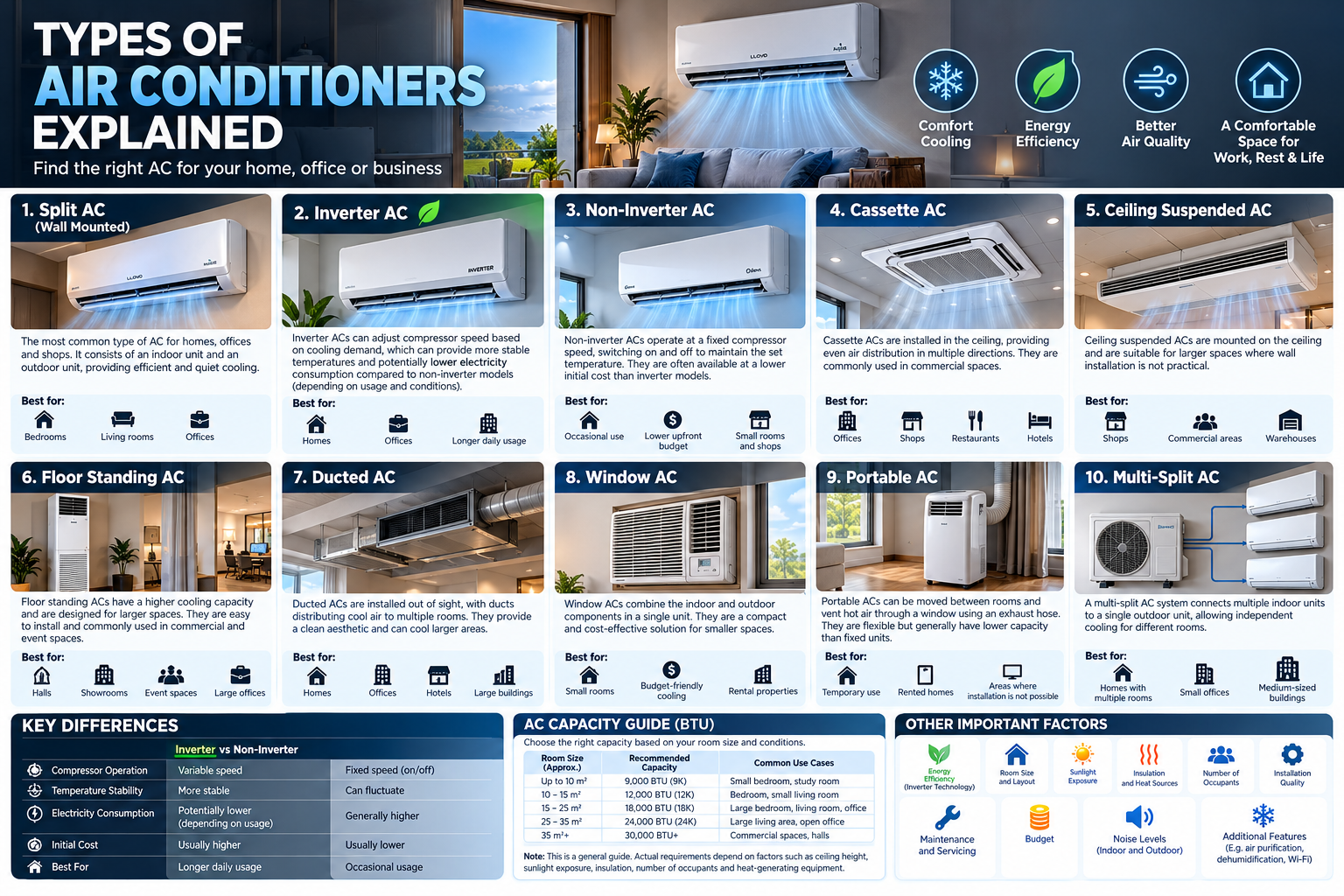
Discover the different types of air conditioners and learn which one is right for your home or business. Explore inverter and non-inverter ACs, split systems, window units, portable ACs, cassette units, ducted systems, multi-split systems, VRF systems, and heat pumps. Understand their advantages, installation requirements, and energy efficiency to make an informed purchasing decision based on your budget, cooling needs, and long-term operating costs.
Choosing an air conditioner is no longer as simple as picking a brand and selecting a cooling capacity. Today's market offers several types of air-conditioning systems, each designed for different spaces, budgets, cooling requirements, and energy needs.
From affordable non-inverter air conditioners to energy-efficient inverter models and powerful commercial systems, understanding the differences can help you make a more informed purchasing decision.
But which type of AC should you choose?
Let's explore the most common types of air conditioners, how they work, and where each one performs best.
1. Inverter Air Conditioners
Inverter air conditioners have become increasingly popular because of their ability to adjust compressor speed according to cooling demand.
Unlike conventional fixed-speed systems, which generally switch their compressors on and off to maintain the desired temperature, inverter systems can vary compressor output to match the room's cooling requirements.
Once the room approaches the target temperature, the compressor can slow down rather than repeatedly stopping and restarting.
Key Advantages
- Potentially lower electricity consumption compared with comparable non-inverter models. - More consistent indoor temperatures. - Reduced compressor start-stop cycling. - Quiet operation at lower compressor speeds on many models. - Suitable for rooms where air conditioning is used for extended periods.
Things to Consider
Inverter air conditioners often have a higher purchase price than comparable non-inverter models.
Their actual energy savings depend on usage patterns, room conditions, equipment efficiency, installation quality, and the temperature setting.
An inverter AC is not automatically the most economical choice for every situation.
Who Should Choose an Inverter AC?
Inverter models are worth considering for bedrooms, living rooms, offices, and other spaces where air conditioning operates regularly.
For households in hot climates such as Sri Lanka, an appropriately sized inverter AC can offer a useful balance between comfort and electricity consumption.
2. Non-Inverter Air Conditioners
Non-inverter air conditioners typically use fixed-speed compressors that operate at a set speed when cooling is required.
When the room reaches the thermostat's target temperature, the compressor switches off. It starts again when additional cooling is needed.
These systems have a straightforward operating principle and are often available at a lower initial purchase price than comparable inverter models.
Key Advantages
- Often lower upfront cost. - Straightforward operating principle. - Available in a wide range of cooling capacities. - Can provide effective cooling when correctly sized and installed. - May be suitable for buyers prioritising initial affordability.
Things to Consider
Because the compressor generally cycles on and off, temperature fluctuations may be more noticeable than with a well-functioning inverter system.
Energy consumption depends on the model's efficiency, operating conditions, and how frequently the compressor runs.
A non-inverter AC is not necessarily inefficient in every situation, but it may be less economical than a comparable inverter model when both are used extensively under similar conditions.
Who Should Choose a Non-Inverter AC?
Non-inverter models can suit budget-conscious customers, rooms used for shorter periods, and applications where the lower initial cost is an important consideration.
The best choice depends on the purchase price, expected electricity consumption, and how long you intend to use the unit.
3. Wall-Mounted Split Air Conditioners
Split air conditioners are among the most common choices for residential and small commercial applications.
A typical split AC consists of two main units:
- Indoor unit: Circulates and cools indoor air. - Outdoor unit: Houses the compressor and other components that transfer heat outside.
The two units are connected by refrigerant piping and electrical connections.
This arrangement allows the indoor unit to operate without the bulky mechanical components being located inside the room.
Key Advantages
- Quiet indoor operation compared with many room-mounted alternatives. - Available in inverter and non-inverter configurations. - Suitable for bedrooms, living rooms, offices, and shops. - Available in different cooling capacities. - Generally offers a clean, space-saving appearance.
Things to Consider
Split ACs require professional installation, including appropriate mounting, piping, drainage, and electrical connections.
The installation location matters. Poor positioning can affect airflow, comfort, and cooling performance.
Who Should Choose a Split AC?
A wall-mounted split AC is often a practical choice for homes, apartments, offices, and smaller commercial spaces where permanent installation is acceptable.
Customers can choose between inverter and non-inverter models depending on their budget and operating requirements.
4. Window Air Conditioners
Window air conditioners combine the principal cooling components into a single unit, typically installed in a suitable window or purpose-built wall opening.
Unlike split systems, they do not require a separate indoor and outdoor unit connected by refrigerant piping.
Key Advantages
- Compact, integrated design. - No separate outdoor condenser unit. - Can be simpler to install where a suitable opening already exists. - Often suitable for individual rooms.
Things to Consider
Window ACs can obstruct part of a window, and installation requires an appropriately sized, structurally suitable opening.
Depending on the model, they may produce more indoor noise than a comparable split AC.
Availability, pricing, and installation suitability also vary by market.
Who Should Choose a Window AC?
Window units may suit smaller rooms, certain apartments, and properties where a split system is impractical but a suitable window or wall opening is available.
5. Portable Air Conditioners
Portable air conditioners are designed to provide cooling without requiring a permanently mounted indoor unit.
Most conventional portable ACs use a hose to discharge hot air outdoors through a suitable window or wall opening.
The unit can generally be moved within a property, although its weight, exhaust arrangement, and drainage requirements affect convenience.
Key Advantages
- Does not normally require a permanently installed split system. - Can be moved between suitable rooms. - May suit temporary cooling requirements. - Useful where permanent installation is restricted.
Things to Consider
Portable air conditioners generally require an exhaust arrangement to remove heat from the room.
Their performance can be affected by air leakage, exhaust installation, humidity, and room conditions.
They may also be noisier and less energy-efficient than comparable split systems.
Who Should Choose a Portable AC?
Portable units may be useful for renters, temporary workspaces, or situations where permanent air-conditioning installation is not practical.
However, compare their actual cooling performance, energy consumption, and installation requirements before purchasing one.
6. Cassette Air Conditioners
Cassette air conditioners are commonly installed in suspended ceilings, with most of the main indoor unit concealed above the ceiling.
The visible panel distributes conditioned air into the room, often in multiple directions depending on the model.
These systems are frequently used in commercial environments where ceiling installation is suitable.
Key Advantages
- Neat appearance with most of the indoor unit concealed. - Can distribute air in multiple directions. - Suitable for certain larger rooms and open commercial spaces. - Keeps wall space available for furniture and other equipment.
Things to Consider
Cassette systems require sufficient ceiling space and appropriate structural support.
Installation, drainage, servicing access, and ceiling modifications must be considered.
They may not be suitable for homes without an appropriate suspended ceiling or sufficient installation space.
Who Should Choose a Cassette AC?
Cassette systems can suit restaurants, retail stores, offices, meeting rooms, and other commercial spaces where ceiling-mounted air distribution is desirable.
7. Ducted Air Conditioning Systems
Ducted air conditioning distributes conditioned air through a network of ducts connected to multiple outlets.
The main equipment is usually concealed in a ceiling space, plant room, or another suitable location.
Depending on the design, a single system can serve several rooms or zones.
Key Advantages
- Discreet appearance with concealed equipment. - Can provide centralised cooling across multiple rooms. - May support separate temperature zones when appropriately designed. - Suitable for certain large residential and commercial buildings.
Things to Consider
Ducted systems typically require more extensive planning and installation than individual split ACs.
The design must account for duct sizing, airflow, insulation, access for maintenance, and the building's cooling load.
Initial installation costs can be substantial, particularly when ductwork must be added to an existing building.
Who Should Choose a Ducted AC?
Ducted systems may be appropriate for larger homes, hotels, offices, and commercial buildings where centralised cooling and discreet installation are priorities.
8. Floor-Standing Air Conditioners
Floor-standing air conditioners are designed to stand on the floor rather than being mounted high on a wall or concealed in a ceiling.
Many models use a separate outdoor unit, similar to a split system.
They are available in different capacities and are often used in spaces that require substantial cooling or have limited suitable wall-mounting options.
Key Advantages
- Suitable for certain larger rooms. - Can provide substantial cooling capacity. - Useful where wall-mounted installation is impractical. - Accessible indoor-unit placement can simplify certain servicing tasks.
Things to Consider
Floor-standing units occupy usable floor space and require careful positioning to avoid obstructing airflow.
The appropriate capacity depends on the room's dimensions, heat load, occupancy, and other environmental factors.
Who Should Choose a Floor-Standing AC?
These systems may suit restaurants, reception areas, meeting rooms, commercial spaces, and larger rooms where their installation format is advantageous.
9. Ceiling-Suspended Air Conditioners
Ceiling-suspended air conditioners are installed beneath the ceiling rather than inside a suspended ceiling cavity.
They can be useful in spaces where there is insufficient ceiling void for a cassette unit or where wall-mounted equipment is unsuitable.
Key Advantages
- Keeps floor space available. - Suitable for certain large or elongated rooms. - Can provide broad air distribution, depending on the model. - Useful in some commercial environments with high ceilings.
Things to Consider
The installation requires suitable structural support and sufficient clearance.
Air distribution must be planned carefully to avoid uncomfortable drafts or uneven temperatures.
Who Should Choose a Ceiling-Suspended AC?
These systems can be suitable for commercial premises, restaurants, workshops, and other spaces where the ceiling provides a practical mounting location.
10. Multi-Split Air Conditioning Systems
A multi-split system connects multiple indoor units to one outdoor unit, subject to the manufacturer's equipment configuration and capacity limits.
Each indoor unit can serve a separate room or area, with control options depending on the system.
This arrangement can reduce the number of outdoor units needed compared with installing an individual split system for every room.
Key Advantages
- Multiple rooms can be served by one outdoor unit. - Reduces the number of outdoor units required. - Provides flexibility in indoor-unit placement. - Can be useful where outdoor space is limited.
Things to Consider
The outdoor unit must have sufficient capacity for the connected indoor units and expected simultaneous cooling demand.
Piping design, equipment compatibility, installation costs, and service requirements must be evaluated.
Depending on the system, a problem with the shared outdoor unit may affect multiple rooms.
Who Should Choose a Multi-Split AC?
Multi-split systems can suit larger homes, apartments, offices, and properties where several rooms require individual indoor units but outdoor-unit space is limited.
11. VRF and VRV Air Conditioning Systems
Variable Refrigerant Flow (VRF) systems, also known as Variable Refrigerant Volume (VRV) systems in certain manufacturers' terminology, are advanced systems designed to serve multiple indoor units through a refrigerant network.
The system adjusts refrigerant flow to meet the cooling or heating demands of connected zones, subject to its design and operating limits.
These systems are commonly considered for larger buildings and more complex commercial applications.
Key Advantages
- Can serve multiple zones. - Allows flexible indoor-unit configurations. - Can adjust output according to changing demand. - Offers sophisticated control options. - May provide efficient operation in appropriately designed applications.
Things to Consider
VRF systems require detailed engineering, specialised installation, compatible equipment, and appropriate commissioning.
Their initial cost and maintenance requirements can be higher than those of conventional residential split systems.
They are generally unnecessary for a typical single-bedroom or small living-room application.
Who Should Choose a VRF System?
VRF systems may suit hotels, office buildings, large residences, commercial complexes, and other properties requiring sophisticated multi-zone climate control.
12. Heat Pump Air Conditioners
Heat pump air conditioners can transfer heat in either direction, depending on the system's operating mode.
In cooling mode, they remove heat from indoors and release it outdoors.
In heating mode, a reversible system can extract heat from the outdoor environment and transfer it indoors.
Many modern split ACs sold in tropical markets are cooling-only models, while others provide both cooling and heating.
Key Advantages
- Can provide cooling and heating in one system when designed for both. - Offers year-round climate control in suitable climates. - Can provide efficient heating compared with some conventional electric resistance heaters.
Things to Consider
Not every air conditioner is a reversible heat pump, and heating performance depends on the model and outdoor conditions.
For customers in hot tropical climates, heating capability may not be a priority.
Who Should Choose a Heat Pump AC?
Heat pump models can be useful in climates where both heating and cooling are required. In warmer regions, customers should focus on cooling performance and the features they will actually use.
---
How Do You Choose the Right Type of Air Conditioner?
Understanding the different types is only the first step. The right choice depends on your space, budget, operating habits, and cooling requirements.
Consider the following factors before purchasing.
1. Room Size and Cooling Capacity
Air conditioners are commonly rated in British thermal units per hour (BTU/h).
For example, a 9,000 BTU/h model is commonly called a 9K BTU AC, while a 12,000 BTU/h model is known as a 12K BTU AC.
However, room floor area alone does not determine the correct capacity.
Ceiling height, sunlight exposure, insulation, window size, occupancy, appliances, and local climate also affect the cooling load.
Choosing the right capacity helps the system operate as intended.
2. Initial Cost vs Long-Term Electricity Consumption
A non-inverter AC may have a lower purchase price, while a comparable inverter model may offer lower electricity consumption under many operating conditions.
Compare the purchase price, energy-efficiency ratings, expected operating hours, and electricity tariff rather than focusing on the initial cost alone.
3. Installation Requirements
Consider whether your property can accommodate a wall-mounted split system, a window unit, a portable AC, or a commercial installation.
Installation conditions can influence the final cost and the system's performance.
4. Noise Levels
Noise may be particularly important in bedrooms, study rooms, offices, and other quiet environments.
Compare the manufacturer's indoor and outdoor sound ratings where available.
5. Maintenance and After-Sales Support
Air conditioners require appropriate maintenance to preserve airflow, performance, and reliability.
Check the manufacturer's maintenance recommendations, warranty terms, availability of spare parts, and access to qualified technicians.
6. Your Actual Cooling Needs
Think about how you intend to use the system.
A bedroom used primarily at night may have different requirements from a shop operating throughout the day or a hotel that needs to cool several rooms.
Choosing a system around your actual requirements can help avoid unnecessary expense.
---
Final Thoughts
There is no single type of air conditioner that is ideal for every property.
Inverter and non-inverter models offer different trade-offs between upfront cost and operating efficiency. Split and window ACs serve individual rooms, while portable units can provide flexibility where permanent installation is difficult.
Cassette, ducted, floor-standing, and ceiling-suspended systems address different installation and air-distribution requirements. Multi-split and VRF systems can serve multiple rooms or zones, while heat pump models can provide both cooling and heating when designed for those functions.
The best air conditioner is the one that matches your cooling requirements, installation conditions, budget, and expected usage.
Before purchasing an AC, compare the system type, cooling capacity, energy efficiency, installation requirements, and long-term operating costs.
A well-informed decision can help you enjoy comfortable indoor temperatures without paying for features or capacity you do not need.