
Air-conditioners
The AC Temperature Myth: Why Setting 16°C Won’t Cool Your Room Faster
By Zernons Team
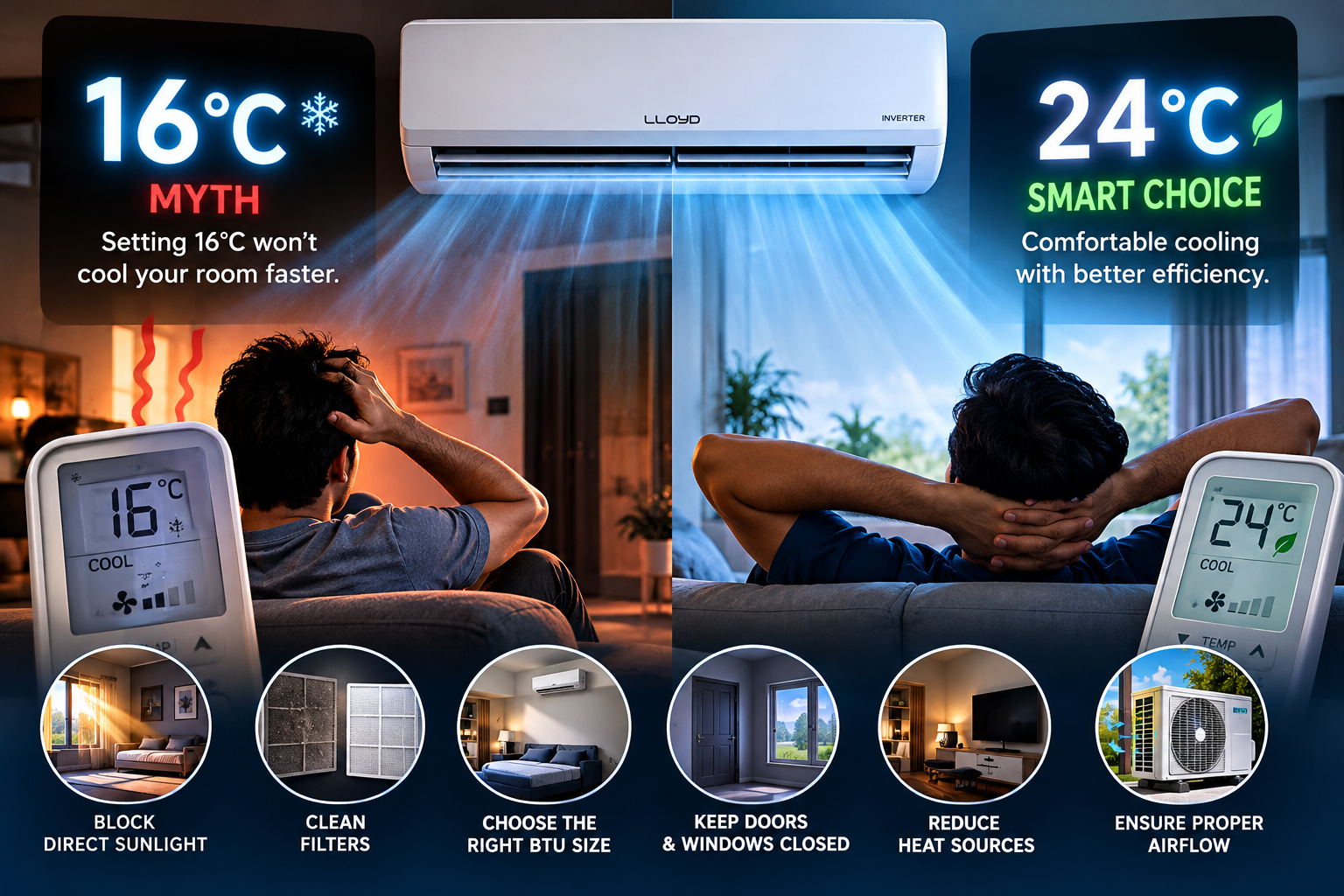
Setting your air conditioner to 16°C won't necessarily cool your room faster. Discover how inverter technology works, why choosing the correct BTU capacity matters, how dirty filters affect cooling performance, and which simple changes can improve comfort and energy efficiency. Learn practical AC tips to make smarter cooling decisions and get more from your air conditioner.
Have you ever walked into a hot room, switched on your air conditioner, and immediately set the temperature to 16°C, hoping to cool the room as quickly as possible?
You're not alone. It's one of the most common misconceptions about air conditioning.
But here's the truth: setting your AC to its lowest temperature doesn't necessarily make it cool your room faster. In many cases, you're simply asking your air conditioner to work towards a much colder temperature than you actually need.
Let's explore why this happens, how your AC really works, and how you can get better cooling without unnecessarily increasing your electricity bill.
1. Your AC Doesn't Work Like a Speed Dial
An air conditioner removes heat from indoor air and transfers it outside. The thermostat monitors the room temperature and helps regulate the cooling process.
When you set your AC to 16°C, you're telling it to aim for a room temperature of 16°C, not instructing it to cool at maximum speed.
For most conventional air conditioners, selecting 16°C instead of 24°C does not automatically increase the cooling capacity of the unit.
Your AC's cooling speed depends on several factors, including its rated capacity, compressor operation, indoor and outdoor temperatures, airflow, and the amount of heat entering the room.
The takeaway: If you want a comfortable room, start with a sensible temperature setting instead of automatically selecting the lowest number.
2. Why 24°C Can Be a Better Choice
For many households, a temperature setting around 24°C to 26°C provides a comfortable balance between cooling and energy consumption.
However, the ideal setting depends on personal comfort, humidity, room conditions, and the climate.
In hot, humid environments such as Sri Lanka, choosing a comfortable temperature while allowing your AC to regulate itself can help avoid unnecessary energy consumption.
Remember that every degree of additional cooling can increase the workload on your air conditioner under certain conditions. The exact effect depends on the unit, the environment, and how it operates.
You don't need to turn your room into a refrigerator to enjoy a comfortable indoor environment.
3. Inverter ACs Are Designed to Adjust Their Performance
This is where inverter technology becomes particularly interesting.
Traditional fixed-speed air conditioners generally switch their compressors on and off to maintain the desired temperature.
Inverter air conditioners can vary compressor speed to match the cooling demand. Once the room approaches the target temperature, an inverter unit can reduce its output rather than repeatedly operating at full capacity.
Depending on the model and operating conditions, this can improve temperature stability and reduce electricity consumption compared with a comparable non-inverter unit.
However, inverter technology isn't magic. An oversized unit, poor installation, dirty filters, or excessive heat entering the room can still undermine performance.
An inverter AC works best when the unit is correctly selected, properly installed, and maintained.
4. Your Room Might Be the Real Problem
Sometimes, the air conditioner isn't the issue. Your room may simply be gaining heat faster than the AC can comfortably remove it.
Consider these common problems:
- Direct sunlight: Sunlight entering through windows can significantly increase the room's cooling demand. - Poor insulation: Heat can enter through roofs, walls, and ceilings. - Open doors and windows: Warm, humid outdoor air can continuously enter the room. - Heat-producing appliances: Computers, televisions, lighting, and other electrical devices release heat. - Incorrect AC capacity: An undersized unit may struggle to cool the space, while an oversized unit may cool the air quickly without adequately controlling humidity in some conditions.
Simple improvements, such as using curtains, reducing unnecessary heat sources, and keeping doors and windows closed while cooling, can make a noticeable difference.
Before assuming you need a more powerful air conditioner, investigate how much heat your room is gaining.
5. The AC Capacity Myth: Bigger Isn't Always Better
Air conditioners are commonly rated in BTUs per hour, which indicate their cooling capacity.
For example, a 9,000 BTU/h air conditioner is often marketed as a 9K BTU AC, while a 12,000 BTU/h model is commonly called a 12K BTU AC.
It's tempting to assume that buying a larger unit will always provide better cooling. In reality, choosing the correct capacity is more important than simply choosing the largest available model.
The right capacity depends on several factors:
- Room floor area and ceiling height. - Number and size of windows. - Sunlight exposure. - Insulation and roof construction. - Number of occupants. - Heat generated by appliances. - Local outdoor temperature and humidity.
A small, shaded bedroom may have very different cooling requirements from a similarly sized room directly beneath a sun-exposed metal roof.
Rather than relying on floor area alone, consider a proper cooling-load assessment when selecting an air conditioner.
6. Dirty Filters Can Quietly Reduce Performance
Here's another problem many people overlook: the air filter.
Your AC continuously circulates indoor air through its filtration system. Over time, dust and other particles can accumulate on the filter, restricting airflow.
Restricted airflow can reduce cooling performance and, in some circumstances, contribute to icing or other operational problems.
The solution is simple: inspect and clean reusable filters according to the manufacturer's instructions.
How frequently you need to clean them depends on usage, dust levels, pets, and the manufacturer's recommendations.
Also, remember that cleaning the filter is not a substitute for professional maintenance when the system needs it.
A clean filter helps your AC move air as intended, but it cannot fix an incorrectly sized unit, refrigerant problems, or installation defects.
7. Closing Every Vent Isn't an Energy-Saving Trick
Some people believe that closing air outlets in unused rooms automatically makes their air conditioner more efficient.
However, many residential split AC systems are designed to cool a particular space rather than distribute conditioned air throughout a house using independently adjustable room vents.
Blocking outlets or obstructing airflow can interfere with the unit's intended operation.
For a typical wall-mounted split AC, the better approach is to keep the indoor unit's airflow unobstructed and ensure that the air can circulate freely throughout the room.
If you want to cool only selected areas of your home, consider how the system is designed before attempting to redirect or restrict airflow.
8. The Most Important AC Upgrade Might Not Be a New AC
Before spending money on another air conditioner, consider whether your existing system is operating as it should.
Check the basics:
1. Set a comfortable target temperature. 2. Clean the air filters when needed. 3. Keep doors and windows closed while cooling. 4. Reduce direct sunlight entering the room. 5. Make sure indoor and outdoor airflow paths are unobstructed. 6. Check that the unit is appropriate for the room. 7. Arrange professional servicing if cooling performance has declined.
If your AC still struggles to cool the room, repeatedly freezes, leaks water, or makes unusual noises, have a qualified technician inspect it.
Do not assume that adding refrigerant is the solution. Refrigerant should be checked by a qualified technician when appropriate, and a leak should be investigated and repaired rather than repeatedly topped up.
Final Thoughts
Air conditioning isn't just about choosing the lowest temperature or buying the most powerful unit you can afford.
It's about matching the system to your room, controlling the heat entering your space, maintaining proper airflow, and operating the unit intelligently.
A correctly selected and maintained inverter AC can provide comfortable cooling while potentially reducing electricity consumption compared with a comparable conventional unit.
So, the next time you switch on your air conditioner, remember this: better cooling begins with understanding your room, not automatically setting your thermostat to 16°C.
Need Help Choosing the Right AC?
At Zernons, we help customers explore air-conditioning solutions suited to their spaces and cooling requirements. Whether you're looking for an economical inverter AC for a bedroom or a higher-capacity model for a larger room, choosing the right unit is the first step towards comfortable, efficient cooling.
Explore our air-conditioning catalogue at Zernons and find a solution that suits your needs.