
Solar Energy Systems
Solar Energy Systems Explained: On-Grid vs Off-Grid vs Hybrid — Which One Is Right for You?
By Zernons Team
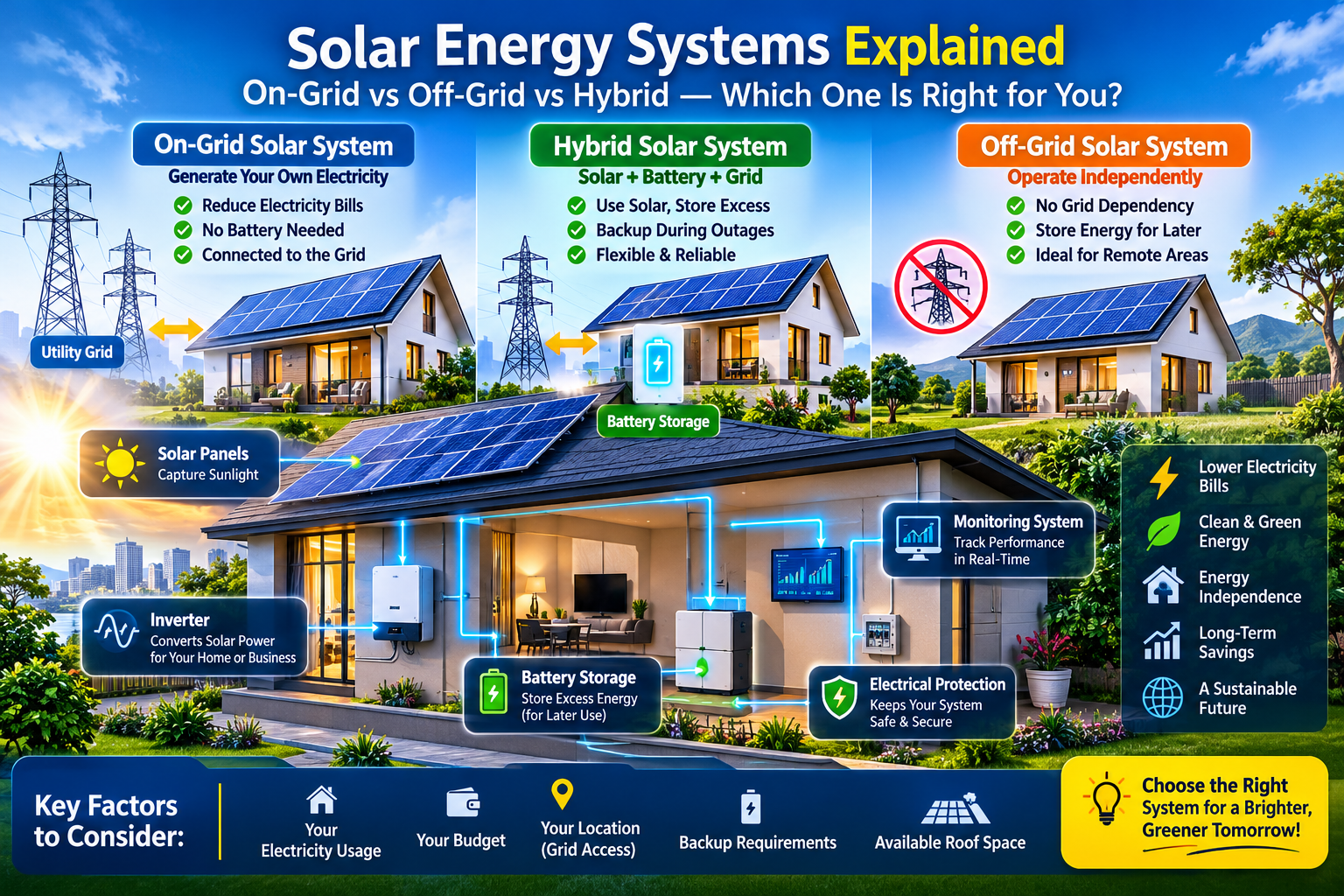
Choosing the right solar energy system involves more than selecting solar panels. Discover the differences between on-grid, off-grid, and hybrid solar systems, understand how batteries and inverters work, and learn how to determine the right system capacity for your home or business. Explore the key considerations for making an informed solar investment, from equipment selection and installation to maintenance and long-term performance.
Solar Energy Systems Explained: On-Grid vs Off-Grid vs Hybrid — Which One Is Right for You?
Solar energy is becoming an increasingly attractive option for homeowners, businesses, hotels, and agricultural operations looking to manage electricity costs and improve energy independence.
However, choosing a solar energy system isn't as simple as purchasing solar panels and installing them on your roof.
Different solar configurations offer different advantages, and the right choice depends on your electricity consumption, budget, location, grid connection, and energy requirements.
Three of the most common configurations are on-grid, off-grid, and hybrid solar energy systems.
Understanding their differences can help you make a smarter investment.
1. On-Grid Solar Systems: Generate Your Own Electricity
An on-grid solar energy system is connected to the electricity grid.
Solar panels generate electricity during daylight hours, supplying power to your property. Depending on the system configuration, surplus electricity may be exported to the grid under an applicable utility arrangement.
When solar generation is insufficient, electricity can be drawn from the grid.
Key advantages
- Potentially reduce electricity bills by generating your own power. - Generally require less upfront investment than comparable battery-equipped systems. - Avoid the additional cost of battery storage. - Offer a practical solution for properties with a reliable grid connection.
What should you know?
Most conventional grid-connected solar inverters automatically shut down during a grid outage to protect utility workers and comply with applicable safety requirements.
This means that a standard on-grid solar system generally cannot power your property during a power cut, even when sunlight is available.
Additional equipment and a suitably designed system are required if backup power is important to you.
Who should consider an on-grid system?
On-grid systems may be suitable for homes, offices, shops, factories, and other properties that have a reliable grid connection and primarily want to reduce their electricity bills.
2. Off-Grid Solar Systems: Operate Independently of the Electricity Grid
An off-grid solar energy system is designed to operate independently of the utility grid.
Solar panels generate electricity, while battery storage allows energy to be saved for use when sunlight is unavailable or insufficient.
Depending on the system design, a generator may also be incorporated as an additional backup source.
Key advantages
- Operate without a utility grid connection. - Store electricity for use at night. - Provide an energy solution for remote properties. - Reduce dependence on external electricity infrastructure.
What should you know?
Off-grid systems require careful planning.
The solar array, inverter, batteries, and other components must be selected according to the property's energy consumption and expected operating conditions.
A system that works well during sunny weather may struggle during extended periods of poor sunlight if its generation and storage capacity are insufficient.
Battery capacity is particularly important when you need to operate equipment at night or maintain essential loads during prolonged cloudy periods.
Who should consider an off-grid system?
Off-grid systems may be suitable for remote homes, rural properties, agricultural facilities, and locations where grid electricity is unavailable or impractical.
They can also be considered where energy independence is a priority and the investment required for sufficient generation and storage is justified.
3. Hybrid Solar Systems: Combine Solar, Batteries, and the Grid
Hybrid solar energy systems combine solar generation and battery storage with a utility grid connection.
Depending on the equipment and system configuration, a hybrid inverter can manage energy from solar panels, batteries, and the grid to meet a property's electricity requirements.
During daylight hours, solar energy can power connected loads and charge the batteries when conditions permit.
When solar generation falls, the system may draw on stored battery energy or electricity from the grid.
Certain hybrid configurations can also provide backup power during grid outages.
However, backup capability depends on the inverter, battery, electrical configuration, and supported backup loads.
Key advantages
- Combine solar generation with battery storage. - Allow stored energy to be used when solar production is low. - Can provide backup power when designed and configured for outages. - Offer greater flexibility in managing electricity consumption. - Can help reduce reliance on grid electricity, depending on usage and system sizing.
What should you know?
Hybrid systems generally cost more than comparable systems without batteries.
Battery selection should consider usable capacity, discharge limits, expected backup duration, power requirements, and compatibility with the inverter.
It's also important to distinguish between battery capacity, measured in kilowatt-hours (kWh), and inverter power, measured in kilowatts (kW).
For example, a 5 kWh battery does not necessarily provide 5 kW of power continuously for an hour under all operating conditions. Actual performance depends on usable battery capacity, discharge limits, system losses, and the loads being supplied.
Who should consider a hybrid system?
Hybrid systems can be attractive for homes, hotels, offices, shops, and businesses that want to reduce electricity costs while maintaining backup capability for selected equipment.
They are particularly worth considering when power interruptions are a concern or when storing solar energy for later use is important.
4. Solar Panels Are Only One Part of the System
One of the biggest misconceptions about solar energy is that installing panels alone is enough to create an effective solar solution.
In reality, a complete solar energy system consists of several interconnected components.
Solar panels: Convert sunlight into electrical energy.
Solar inverter: Converts and manages electrical power according to the system configuration.
Battery storage: Stores electricity for later use when included in the system.
Mounting structures: Secure the panels and help maintain the required orientation and installation integrity.
Electrical protection: Includes appropriately selected protective devices, isolation, earthing, and other safety provisions.
Monitoring equipment: Helps users and service providers track system performance when supported by the installed equipment.
Installation and commissioning: Ensure that the system is installed, configured, tested, and documented appropriately.
Every component must work together.
Poor equipment selection, unsuitable system sizing, incorrect installation, or inadequate protection can compromise performance, reliability, and safety.
That's why choosing a solar provider should involve more than comparing the prices of individual panels and inverters.
5. How Much Solar Capacity Do You Actually Need?
Another common mistake is selecting a solar system based solely on the available roof space or a neighbour's installation.
The right system capacity depends on how much electricity your property consumes and when that electricity is used.
A proper assessment should consider:
- Monthly electricity consumption. - Daytime versus nighttime electricity demand. - Major appliances and equipment. - Roof orientation, shading, and available installation space. - Local weather conditions. - Existing electrical infrastructure. - Battery backup requirements. - Applicable utility connection and export requirements. - Budget and expected financial returns.
For example, a business that consumes substantial electricity during daylight hours may benefit from an appropriately sized on-grid system.
A rural property with no grid connection may need an off-grid system with sufficient battery storage.
Meanwhile, a household that wants to reduce grid consumption and maintain selected essential loads during outages may benefit from a properly designed hybrid system.
The objective isn't to install the biggest system possible. It's to install a system that matches your actual energy requirements.
6. What About Solar Batteries?
Battery storage is one of the most important considerations when designing an off-grid or hybrid solar system.
However, not every solar installation needs a battery.
For a property focused primarily on reducing electricity bills, an on-grid system without battery storage may be more financially appropriate.
For a property that requires backup electricity, battery storage can provide additional flexibility.
When selecting a battery, consider:
- Usable energy capacity in kWh. - Maximum continuous and peak discharge power. - Compatibility with the inverter. - Expected backup duration. - Battery chemistry and operating limits. - Manufacturer warranty and service support. - Future expansion requirements.
It is also important to calculate which appliances need backup power.
Powering a few lights, a router, and essential electronics requires a different system design from powering air conditioners, pumps, refrigerators, and other high-demand equipment simultaneously.
A properly designed system should reflect those differences.
7. Solar Energy for Homes, Businesses, Hotels, and Agriculture
Solar energy isn't limited to residential rooftops.
Different sectors can benefit from different system configurations.
Residential properties: Reduce reliance on grid electricity and potentially lower electricity bills.
Hotels and resorts: Support daytime electricity consumption and, where appropriate, integrate battery storage for selected loads.
Shops and offices: Generate electricity during business hours when demand may coincide with solar production.
Factories and commercial facilities: Explore solar installations based on operational demand, available roof space, electrical infrastructure, and investment objectives.
Agricultural properties: Consider solar-powered pumping and other applications where energy requirements and operating conditions support the investment.
Rural and remote properties: Use appropriately designed off-grid or hybrid systems where conventional grid access is limited.
Each application requires an assessment of its own energy consumption, operating schedule, site conditions, and technical requirements.
A system designed for a small residence should not automatically be treated as suitable for a commercial facility or agricultural operation.
8. Why Professional System Design and Installation Matter
A solar energy system is a long-term investment, so its design and installation deserve careful attention.
Before installation, the provider should evaluate the property's energy requirements, assess the proposed installation location, select compatible equipment, and determine the appropriate system configuration.
Where applicable, utility approvals and connection requirements must also be addressed.
Installation should follow relevant electrical safety requirements and manufacturer instructions.
After installation, commissioning and testing help verify that the system operates as intended.
Customers should also understand the system's monitoring facilities, warranty terms, maintenance requirements, and available technical support.
Solar equipment quality matters, but so does the quality of the engineering, installation, and ongoing service behind it.
9. Choosing the Right Solar Energy Partner
When comparing solar providers, avoid making your decision based exclusively on the lowest quotation.
Instead, consider the complete solution being offered.
Ask whether the provider will:
- Assess your electricity consumption and energy requirements. - Recommend an appropriate system configuration. - Explain the selected equipment and its specifications. - Address applicable approvals and utility connection requirements. - Provide professional installation and commissioning. - Explain system monitoring and performance expectations. - Clarify equipment, workmanship, and battery warranties. - Offer maintenance and after-sales support.
A reliable provider should explain what the system can do, what it cannot do, and what you can reasonably expect from your investment.
Transparency is particularly important when comparing on-grid, off-grid, and hybrid systems because their capabilities and costs can differ substantially.
Final Thoughts
Solar energy offers opportunities for households and businesses to generate electricity from a renewable source and potentially reduce their dependence on conventional grid power.
However, the best solution depends on your requirements.
An on-grid system may be appropriate when reducing electricity bills is the primary objective.
An off-grid system may suit properties that need to operate independently of the utility grid.
A hybrid system may offer a useful balance between solar generation, battery storage, and grid connectivity.
Before investing, evaluate your energy consumption, budget, backup requirements, and long-term objectives.
A successful solar installation starts with the right system design, not simply the number of panels on your roof.
Looking for a Solar Energy Solution?
At Zernons, we approach solar energy as a complete system rather than simply a collection of components.
From equipment selection and system design to applicable approvals, installation, commissioning, monitoring, and maintenance support, our goal is to help customers identify solar solutions suited to their requirements.
Whether you're planning a residential installation, a commercial solar project, or a solar-powered water pumping system, understanding your energy needs is the first step.
Explore Zernons Solar Energy Systems and discover a solution designed around your energy requirements.