
Solar Energy Systems
Solar Energy Myth: Do Solar Panels Stop Working on Cloudy Days? The Truth About Solar Power
By Zernons Team
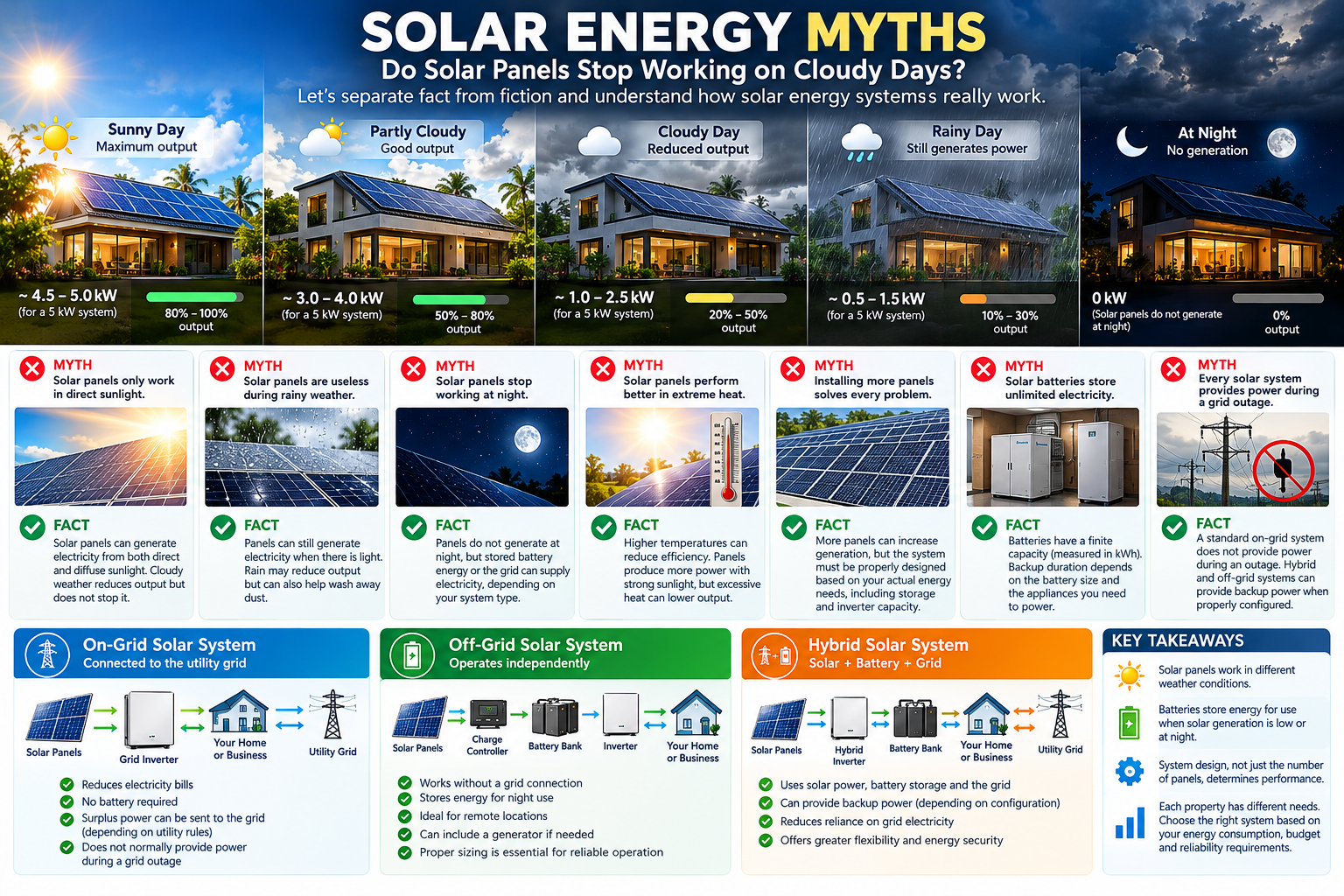
Do solar panels stop working when the weather turns cloudy? Not necessarily. Solar panels can generate electricity from diffuse sunlight, although output typically decreases during cloudy weather. Discover how on-grid, off-grid, and hybrid solar systems operate, how batteries provide stored electricity after sunset, and why proper system sizing matters. Learn the truth behind common solar energy myths and make a more informed decision about investing in solar power in Sri Lanka.
Have you ever wondered whether solar panels become useless when the sky turns cloudy or the sun disappears behind a thick layer of clouds?
It's a common misconception that solar energy systems only work when direct sunlight is available.
This belief leads many homeowners and business owners to question whether investing in solar energy is worthwhile, particularly in tropical countries like Sri Lanka, where cloudy weather and seasonal rainfall are common.
But here's the truth: solar panels can still generate electricity on cloudy days, although their output is generally lower than under strong sunlight.
Understanding how solar energy systems actually work can help you make a more informed decision about your energy needs.
Let's separate fact from fiction.
1. Myth: Solar Panels Only Work in Direct Sunlight
One of the biggest misconceptions about solar energy is that solar panels need bright, direct sunlight to generate electricity.
In reality, photovoltaic (PV) panels convert light into electrical energy. They can generate electricity from both direct sunlight and diffuse sunlight scattered through clouds.
However, the amount of electricity they produce depends on the intensity of the available light.
On a bright, sunny day, a solar installation may generate substantial power. On a heavily overcast day, its output can fall considerably.
The precise reduction depends on cloud thickness, weather conditions, panel characteristics, shading, and the overall system configuration.
The takeaway: Cloudy weather reduces solar generation, but it does not necessarily stop it.
2. Myth: Solar Panels Become Useless During Rainy Weather
Sri Lanka experiences seasonal rainfall, making this an especially relevant concern for local homeowners and businesses.
Rain can reduce the sunlight reaching solar panels, temporarily lowering electricity generation. However, the panels can continue producing electricity whenever sufficient light is available.
Rain may also wash away some accumulated dust and loose surface debris, although it should not be considered a substitute for proper inspection and cleaning when needed.
The important consideration is not whether solar panels can generate electricity during every rainy hour. It is how much electricity the system produces over time relative to the property's consumption.
A well-designed system accounts for local weather patterns and expected seasonal variations.
For properties that require dependable electricity during prolonged periods of poor sunlight, battery storage or another suitable backup source may be worth considering.
3. Myth: Solar Panels Stop Working at Night, So Solar Energy Is Pointless
This misconception confuses solar generation with energy storage.
Solar panels generally do not generate meaningful electricity at night because sunlight is unavailable.
However, that does not mean a solar-powered property must go without electricity after sunset.
There are several ways to manage electricity requirements at night.
Option A: On-Grid Solar Systems
An on-grid system connects a property's solar installation to the utility grid.
During daylight hours, the system can supply electricity to the property and may export surplus electricity to the grid, subject to the applicable utility arrangement.
At night, the property can draw electricity from the grid.
This arrangement can be attractive for customers primarily interested in reducing electricity bills without purchasing battery storage.
However, a conventional grid-connected inverter generally shuts down during a grid outage for safety reasons. Solar panels alone therefore do not normally provide backup power during an outage.
Option B: Off-Grid Solar Systems
An off-grid system operates independently of the utility grid.
It typically combines solar panels, an inverter, and battery storage to supply electricity when sunlight is unavailable.
During daylight hours, the system can generate electricity for immediate use while charging the batteries when sufficient surplus energy is available.
At night, stored battery energy can supply connected appliances.
However, the system must be properly sized to account for nighttime consumption, battery limitations, and periods of reduced solar generation.
Option C: Hybrid Solar Systems
A hybrid system combines solar generation and battery storage with a utility grid connection.
Depending on the equipment and configuration, it can use solar electricity during the day, store surplus energy in batteries, and draw electricity from the grid when required.
Some hybrid systems can also provide backup power during grid outages when configured with compatible batteries and suitable backup circuits.
This makes hybrid systems an option for customers who want to reduce grid consumption while maintaining power for selected appliances during outages.
The key lesson: Solar panels generate electricity, while the grid and battery storage can help meet energy requirements when solar generation is insufficient.
These functions are different, and choosing the right configuration depends on your needs.
4. Myth: Solar Panels Perform Better in Extremely Hot Weather
It may seem logical that hotter weather always produces more solar electricity.
After all, solar panels rely on sunlight.
However, sunlight intensity and temperature are two different factors.
Solar panels generally produce more power when they receive stronger sunlight, but photovoltaic modules typically become less efficient as their operating temperature rises above their reference test temperature.
This means a bright, hot day can provide excellent solar generation, but excessive panel temperatures can reduce efficiency compared with the same sunlight conditions at a lower panel temperature.
The actual output depends on the panel's specifications, installation, ventilation, sunlight intensity, and other environmental conditions.
Proper installation and equipment selection help ensure that the system operates within its intended limits.
5. Myth: Installing More Solar Panels Automatically Solves Every Electricity Problem
More solar panels can increase the potential electricity generation of a system, provided the inverter, electrical design, and installation support the additional capacity.
However, simply adding panels does not guarantee that a property will have sufficient electricity at all times.
Consider a business that consumes substantial electricity after sunset.
Increasing the solar panel capacity may generate more electricity during daylight hours, but it does not automatically provide additional nighttime energy unless the system can store that energy or use another suitable source.
Similarly, a property that experiences extended periods of cloudy weather may require a combination of appropriately sized solar generation, battery storage, and backup power.
The system should be designed around actual energy consumption rather than panel count alone.
Before expanding a solar installation, consider:
- Daily and monthly electricity consumption. - Daytime versus nighttime energy demand. - Available roof or ground installation space. - Seasonal weather conditions. - Inverter capacity and compatibility. - Battery storage requirements. - Budget and expected financial returns.
The goal is to design the right system, not simply install the largest possible array.
6. Myth: Solar Batteries Store Unlimited Electricity
Battery storage can make solar energy more flexible, but batteries have finite capacities.
Battery capacity is commonly measured in kilowatt-hours (kWh), while an inverter's power output is measured in kilowatts (kW).
For example, a nominal 5 kWh battery does not necessarily deliver 5 kWh of usable electricity to appliances. Usable energy depends on the battery's specifications, permitted depth of discharge, operating conditions, and system losses.
The duration for which a battery can power your property also depends on the appliances connected to it.
Running a few lights, a Wi-Fi router, and essential electronics requires less energy than operating multiple air conditioners, refrigerators, water pumps, and other high-demand appliances simultaneously.
A battery system should therefore be sized according to the loads that need backup and the expected duration of operation.
Customers should also consider battery compatibility, warranty terms, operating limits, and future expansion requirements.
7. Myth: Every Solar System Provides Electricity During a Power Cut
This is one of the most important misconceptions to understand before purchasing a solar installation.
Not every solar energy system provides backup electricity during a grid outage.
A conventional on-grid system normally disconnects from the grid during an outage because of electrical safety requirements.
A properly configured hybrid system may provide backup power through a designated backup output, provided compatible storage and the necessary equipment are installed.
An off-grid system is designed to operate without a utility grid connection, although its ability to supply electricity depends on available generation, stored energy, and system design.
Before choosing a system, ask the installer:
- Will the system supply electricity during a grid outage? - Which appliances can operate during an outage? - Is battery storage included? - How long can the batteries support the expected loads? - Can the system recharge its batteries during the day? - What happens during several consecutive days of poor sunlight?
Clear answers to these questions can help prevent unpleasant surprises after installation.
8. So, Is Solar Energy Worth It in Sri Lanka?
Solar energy can be a worthwhile investment in Sri Lanka, but the financial and practical benefits depend on the property and system design.
Before investing, evaluate your electricity consumption, local solar conditions, available installation space, applicable electricity tariffs, utility connection arrangements, and installation costs.
An on-grid system may be appropriate when reducing electricity bills is the primary objective.
An off-grid system may suit a property without a reliable grid connection.
A hybrid system may be attractive when both grid connectivity and battery-backed electricity are important.
It is also essential to consider seasonal weather variations when estimating annual electricity generation.
Rather than relying exclusively on the number of sunny days, assess expected energy production over the year and compare it with your actual electricity requirements.
A professional system assessment can help establish realistic expectations for generation, backup duration, operating costs, and potential savings.
Final Thoughts
Solar energy is not limited to perfectly sunny days, nor does cloudy weather automatically make a solar installation useless.
Solar panels can generate electricity from diffuse sunlight, although their output generally decreases when less sunlight reaches them.
Battery storage can help make solar electricity available after sunset, while grid-connected systems can draw electricity from the utility when solar generation is insufficient.
However, not every solar system offers backup power during outages, and batteries cannot supply unlimited electricity.
The best solution depends on your property's energy consumption, budget, location, and reliability requirements.
The real secret to successful solar energy isn't expecting sunlight to be available all the time. It's designing a system that works with changing weather conditions and your actual electricity needs.
Before investing, compare on-grid, off-grid, and hybrid configurations, understand their limitations, and choose a system designed around your requirements.
An informed decision can help you get more value from solar energy while setting realistic expectations about its performance.
Frequently Asked Questions
1. Do solar panels work on cloudy days?
Yes. Solar panels can generate electricity from diffuse sunlight, although output is generally lower than under strong, direct sunlight.
2. Can solar panels generate electricity during rain?
They can generate electricity when sufficient light reaches them. Heavy cloud cover and rainfall may reduce output considerably.
3. Do solar panels work at night?
Solar panels generally do not generate meaningful electricity at night. Electricity can instead come from battery storage or the utility grid, depending on the system.
4. Can solar power run an air conditioner?
Yes, if the system is properly designed to meet the air conditioner's electrical demand. The required inverter capacity, solar generation, and battery storage depend on the AC's power consumption and intended operating hours.
5. Which solar system is best for a home?
An on-grid system may suit households focused on reducing electricity bills, an off-grid system may suit properties without grid access, and a hybrid system may suit households that want battery storage and suitable backup capability.
The best choice depends on your electricity consumption, budget, grid connection, and backup requirements.